
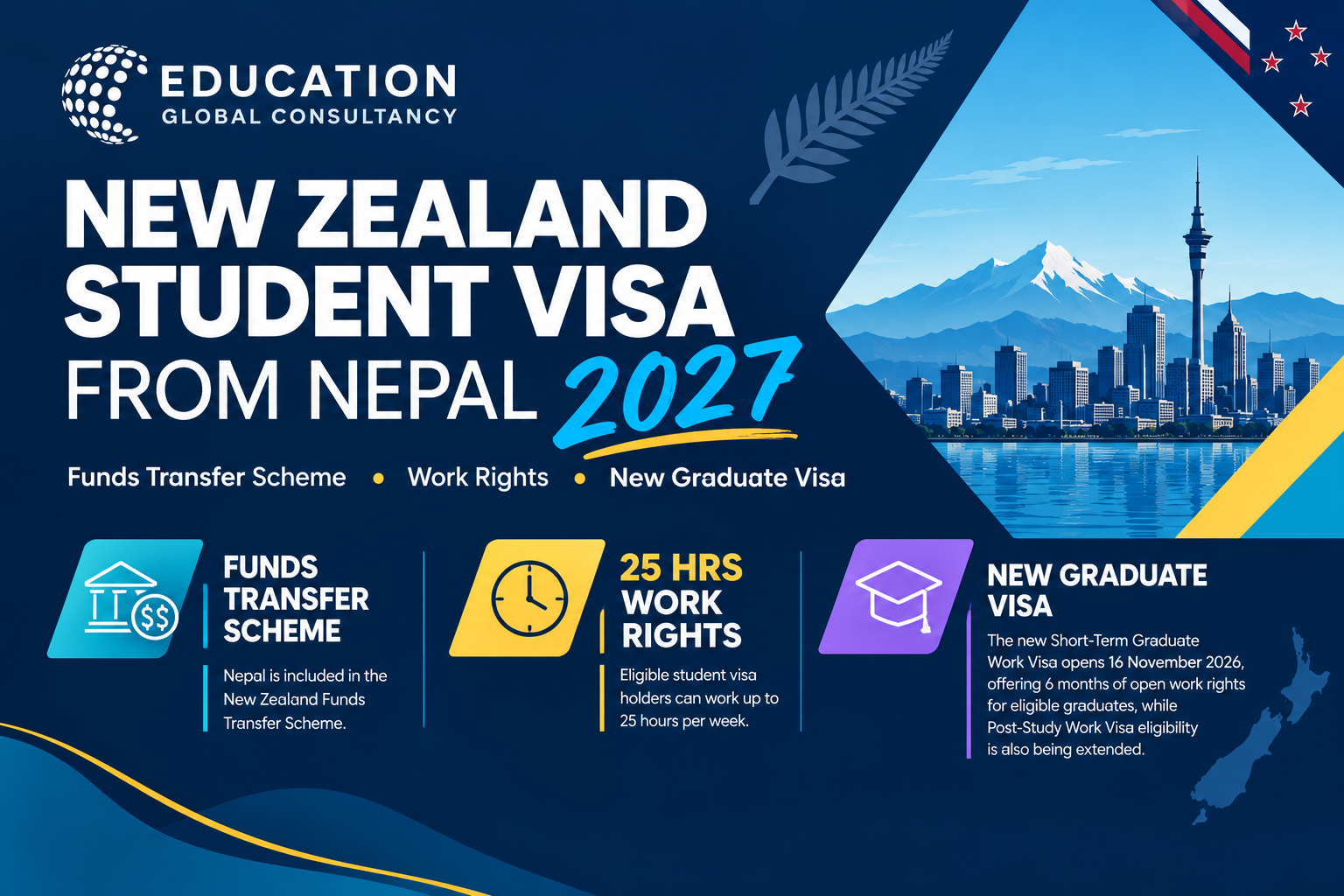
To get a New Zealand student visa from Nepal for 2027, you need these things:
- an offer of place from an approved New Zealand provider
- your first year’s tuition paid
- proof of NZD 20,000 a year for living costs, plus a ticket home or the money for one
- health insurance
- health and character checks
The visa costs from NZD 850. Since 2 April 2026, most Nepali students approved in principle must move their living funds through Immigration New Zealand’s Funds Transfer Scheme. Once you arrive, you can work up to 25 hours a week during term. From 16 November 2026, a new 6-month graduate work visa and a wider Post-Study Work Visa open up more options after study. Nepal’s approval rate was 52% in 2025, so a careful, well-evidenced application matters.
What’s new for Nepali students in 2026–27
Four changes shape the 2027 intakes for Nepali applicants. Most of them are not covered in older guides.
| Change | Date | What it means for you |
|---|---|---|
| Nepal added to the Funds Transfer Scheme (FTS) | From 2 April 2026 | Most Nepali students approved in principle must deposit their living funds into an FTS account with a New Zealand bank before the visa is finalised. |
| Student work rights raised from 20 to 25 hours a week | Visas granted from 3 November 2025 | More part-time income during term, and full-time work in scheduled holidays (subject to visa conditions). |
| New Short-Term Graduate Work Visa (6 months) | Opens 16 November 2026 | Graduates of eligible Level 5–7 qualifications who can’t get a Post-Study Work Visa now have 6 months of open work rights. |
| Post-Study Work Visa extended to Level 7 graduate diplomas | From 16 November 2026 | If you already hold a bachelor’s degree (from Nepal or anywhere else), a NZ graduate diploma can now lead to a PSWV of up to 1 year. |
Nepal’s approval rate: why preparation matters
In 2025, Immigration New Zealand (INZ) decided 1,957 offshore student visa applications from Nepal. It approved 1,024 (52%) and declined 918 (47%). Across all countries, the approval rate was 83% (INZ data as of 16 February 2026).
That gap doesn’t mean New Zealand is closed to Nepali students. It means INZ looks closely at three things: whether you are a genuine student, where your money comes from, and whether your course fits your background. Most declines can be avoided with a clear study plan and clean financial evidence.
New Zealand student visa requirements from Nepal (2027)
The Fee Paying Student Visa is the main visa for full-time international students. It can be issued for up to 4 years and usually covers the period of study you have paid for.
1. Offer of place
Your offer must come from an approved education provider that has signed the Education (Pastoral Care of Tertiary and International Learners) Code of Practice 2021. It must show:
- the course name
- the course length
- whether you will study full-time or part-time
- the holiday dates, for courses longer than one academic year
You can apply with a conditional offer from outside New Zealand. You will need an unconditional offer before the visa is approved.
2. Tuition fees
You must show that you have paid tuition for one year, or for the whole course if it is shorter. INZ accepts payment receipts or confirmation from your provider. It does not accept screenshots of bank transfers or receipts from education agents.
3. Living costs (maintenance funds)
- NZD 20,000 per year for tertiary or English-language study of one year or more
- NZD 1,667 per month for study shorter than one year
- You also need a paid ticket out of New Zealand, or enough extra money to buy one.
The money can be your own, or it can come from a sponsor or guarantor. Nepal-specific rule: for applicants from Nepal applying in South Asia, only immediate family can sponsor you or sign a financial undertaking. That means a partner, parents, siblings, grandparents or parents-in-law.
4. English language
INZ does not require an English test for the visa itself. Instead, your provider must confirm you have the English and academic ability to pass your course. Universities set their own IELTS, PTE or TOEFL minimums for each programme, so check your offer conditions. A good score also supports your case as a genuine student.
5. Health, character and insurance
- Chest X-ray: needed if you will stay more than 6 months and come from a country without a low TB rate. Most Nepali applicants should plan for one. It must be less than 3 months old when you apply.
- Police certificate: needed if you are 17 or older and will be in New Zealand for 24 months or more. It must be less than 6 months old.
- Insurance: you need travel and health insurance from the start of your course until your visa ends. The policy must be acceptable to your provider.
How the Funds Transfer Scheme works for Nepali students
The FTS is the biggest new step for Nepali applicants in 2026–27. Here is how it runs:
- INZ assesses your application. If it approves you in principle, it sends an Approval in Principle (AIP) letter. The letter says whether you must use the FTS.
- You open an FTS savings account and an everyday account with a participating New Zealand bank.
- You transfer your living funds, at least NZD 20,000 for each year of study, into the FTS savings account. Tuition is paid to your provider separately.
- Your bank confirms the deposit to INZ. You send your tuition receipt, and INZ finalises your visa. When the FTS is a condition of your AIP, you usually get 15 days to complete these steps.
- After you arrive, a monthly automatic payment moves money to your everyday account. On a NZD 20,000 deposit, that is up to about NZD 1,666 a month.
INZ says the scheme shows you have real access to your money, and it expects the scheme to speed up processing for Nepal. It does not guarantee approval. You can get a refund if your visa is declined. Tip: have the full amount ready and traceable before you apply, because 15 days is not long for an international transfer.
How much money you need: a budget checklist
Your exact total depends on your course. Use your offer letter for tuition and these official minimums for the rest.
| Item | Amount | Notes |
|---|---|---|
| Tuition (year 1, or the full course if shorter) | As per your offer letter | Must be paid before the visa is finalised |
| Living costs | NZD 20,000 per year (NZD 1,667 per month if under 1 year) | Moved through the FTS for most Nepali applicants |
| Outward travel | A paid ticket or the equivalent funds | Required by INZ |
| Student visa application | From NZD 850 | Check the INZ fee finder when you apply |
| Health and travel insurance | Varies by provider and policy | Must cover the whole visa period |
| Medical (chest X-ray) and police certificate | Varies in Nepal | Use INZ-approved panel clinics |
INZ also checks where the money came from. It accepts bank statements covering the last 3 months, fixed deposits held for at least 3 months, and education loans from a nationalised or multinational bank. Be ready to explain any large deposit over NZD 2,000, and keep proof of income such as tax returns, salary slips, business registration or rental income.
2027 intakes and when to apply
Most universities have two main intakes: Semester One (February/March) and Semester Two (July). Some polytechnics and private providers offer more start dates.
| Intake | Typical start | Admission deadline (example) | Visa timing |
|---|---|---|---|
| Semester One 2027 | February/March 2027 | University of Auckland undergraduate: 1 July 2026 to 31 January 2027, by programme (Nursing international: 1 Nov 2026) | INZ advised applying around September 2026. Apply now if you haven’t. |
| Semester Two 2027 | July 2027 | University of Auckland undergraduate international: 8 June 2027 | Apply at least 3 months before travel, so by about March–April 2027 |
INZ’s busiest months are October to March, and applications from Nepal and other South Asian countries can take longer. If you miss your intake and can’t start until later, INZ generally suggests withdrawing and asking for a refund rather than leaving the application open.
Step-by-step: applying from Nepal
- Shortlist courses that follow on logically from your past study or work. Course fit is a key part of the genuine student test.
- Take an English test if your provider requires one, and meet any offer conditions.
- Get your offer, accept it and pay your first year’s tuition.
- Prepare your financial file: 3 months of statements, documents showing where the money came from, and sponsor documents from immediate family only.
- Book your chest X-ray and, if needed, a police certificate.
- Write a clear study plan that explains your course choice, your career goals and why New Zealand.
- Apply online for the Fee Paying Student Visa and pay the fee.
- Get approval in principle, complete the FTS deposit and send your tuition receipt within the deadline.
- Receive your eVisa, buy insurance and book travel.
Working while you study
On visas granted from 3 November 2025, you can work up to 25 hours a week during term and full-time in scheduled holidays, depending on your visa conditions. If you hold an older visa that allows 20 hours, you can apply to vary your conditions (fee NZD 325) or wait until your next visa. Part-time work helps with living costs, but INZ won’t count future wages as proof of funds.
After you graduate: PSWV or the new 6-month visa
| Post-Study Work Visa | Short-Term Graduate Work Visa (new) | |
|---|---|---|
| Opens | Available now (expanded from 16 Nov 2026) | 16 November 2026 |
| Length | Up to 3 years, depending on qualification level and study time | 6 months, open work rights |
| Main eligibility | Degree at Level 7 or above with at least 30 weeks of full-time study in NZ, or an eligible non-degree qualification. From 16 Nov 2026, a Level 7 graduate diploma plus a bachelor’s degree (PSWV up to 1 year). | Level 5–7 qualification, full-time for at least 24 weeks in NZ, that doesn’t qualify for a PSWV. English, foundation and bridging courses excluded. |
| Funds | At least NZD 5,000 | At least NZD 5,000 |
| Apply by | Usually within 3 months of your student visa expiring | Within 3 months of your student visa expiring |
| Fee | From NZD 1,670 | NZD 1,670 (reported) |
| Family | Can support partner and children’s visas if requirements are met | Cannot sponsor a partner’s work visa or children’s student visas |
You can hold only one PSWV, and anyone who has held a PSWV can’t get the short-term visa. Choose your course with your post-study plan in mind.
Common mistakes Nepali applicants should avoid
- Choosing a course that doesn’t fit your previous study or work, without explaining why.
- Large or recent deposits with no paper trail.
- Using a sponsor who isn’t immediate family.
- Sending agent receipts or transfer screenshots as proof of tuition.
- Applying in November or December for a February start.
- Not having FTS funds ready for the 15-day window after approval in principle.
FAQs
How much bank balance is needed for a New Zealand student visa from Nepal? You need NZD 20,000 for each year of living costs (or NZD 1,667 a month for shorter courses), plus your first year’s tuition paid and a return ticket or funds for one. Most Nepali students now move the living funds through the Funds Transfer Scheme.
Is the Funds Transfer Scheme compulsory for Nepali students? For most Nepali students approved in principle, yes, since 2 April 2026. Your Approval in Principle letter will say whether you must use it.
Is IELTS required for a New Zealand student visa? Not by INZ. Your university or college sets the English requirement, and most accept IELTS, PTE or TOEFL.
How long does a New Zealand student visa take from Nepal? INZ says 80% of Fee Paying Student Visa applications are decided within 8 weeks. Applications from Nepal can take longer in the October–March peak, so apply at least 3 months before travel.
How many hours can I work in New Zealand as a student? Up to 25 hours a week during term on visas granted from 3 November 2025, and full-time in scheduled holidays, subject to your visa conditions.
Can my uncle or a family friend sponsor me? For applicants from Nepal applying in South Asia, only immediate family (partner, parents, siblings, grandparents or parents-in-law) can sponsor you or sign a financial undertaking.
What is the new Short-Term Graduate Work Visa? It is a 6-month open work visa opening on 16 November 2026. It is for graduates of eligible Level 5–7 qualifications that don’t lead to a Post-Study Work Visa.
How Education Global can help
Education Global helps Nepali students choose the right New Zealand course and provider, prepare a strong study plan and organise financial documents that INZ can verify. We also guide you through each step of the visa and pre-departure process. If you are aiming for February or July 2027, now is the time to plan. Speak to an Education Global counsellor or book a free discovery call.