
For Nepali students who have studied in the UK and want to build a career and a life there, the Graduate Route Visa is the first step but it is not the destination. The Graduate Route gives you two or three years of unrestricted work without a job offer. What comes next, if you want to remain in the UK long-term, is the Skilled Worker Visa.
The Skilled Worker Visa is the primary long-term immigration route for non-EEA nationals working in the UK. It is the bridge between your Graduate Route and Indefinite Leave to Remain (ILR). This guide explains everything a Nepali graduate needs to know about the Skilled Worker Visa – eligibility, salary requirements, how to find a sponsoring employer, and how it fits into the longer pathway to settlement.
What Is the Skilled Worker Visa?
The Skilled Worker Visa allows non-UK nationals to live and work in the UK in an eligible role with a UKVI-approved sponsoring employer. Unlike the Graduate Route, it requires a confirmed job offer from a licensed sponsor before you can apply. It is renewed every three years and can be extended – and crucially, time spent on the Skilled Worker Visa counts toward the five-year continuous residence requirement for ILR.
The Four Requirements for a Skilled Worker Visa
1. A Job Offer From a Licensed Sponsor
The employer offering you the role must hold a UKVI Sponsor Licence. The Home Office publishes a full register of licensed sponsors, which you can search online. Not all UK employers hold a Sponsor Licence – in fact, only a minority do. Before accepting or prioritising any job offer during your Graduate Route, check whether the employer can sponsor you. If they cannot and are unwilling to apply for a licence – that job cannot lead to a Skilled Worker Visa regardless of the salary or seniority.
2. Eligibility of the Role
The role must be classified as RQF Level 3 or above in the UK’s Regulated Qualifications Framework — broadly equivalent to A-level or above in skills requirement. This covers the majority of professional, technical, managerial, and specialist roles. Manual or routine work at a lower skill level does not qualify, even if it pays above the salary threshold.
3. Meeting the Salary Threshold
This is the most significant practical hurdle for Nepali graduates in 2026. The general minimum salary threshold for the Skilled Worker Visa is £38,700 per year gross – the rate that has applied since April 2024. Some shortage occupations and roles in the NHS and social care qualify at different rates, but the general floor is substantial.
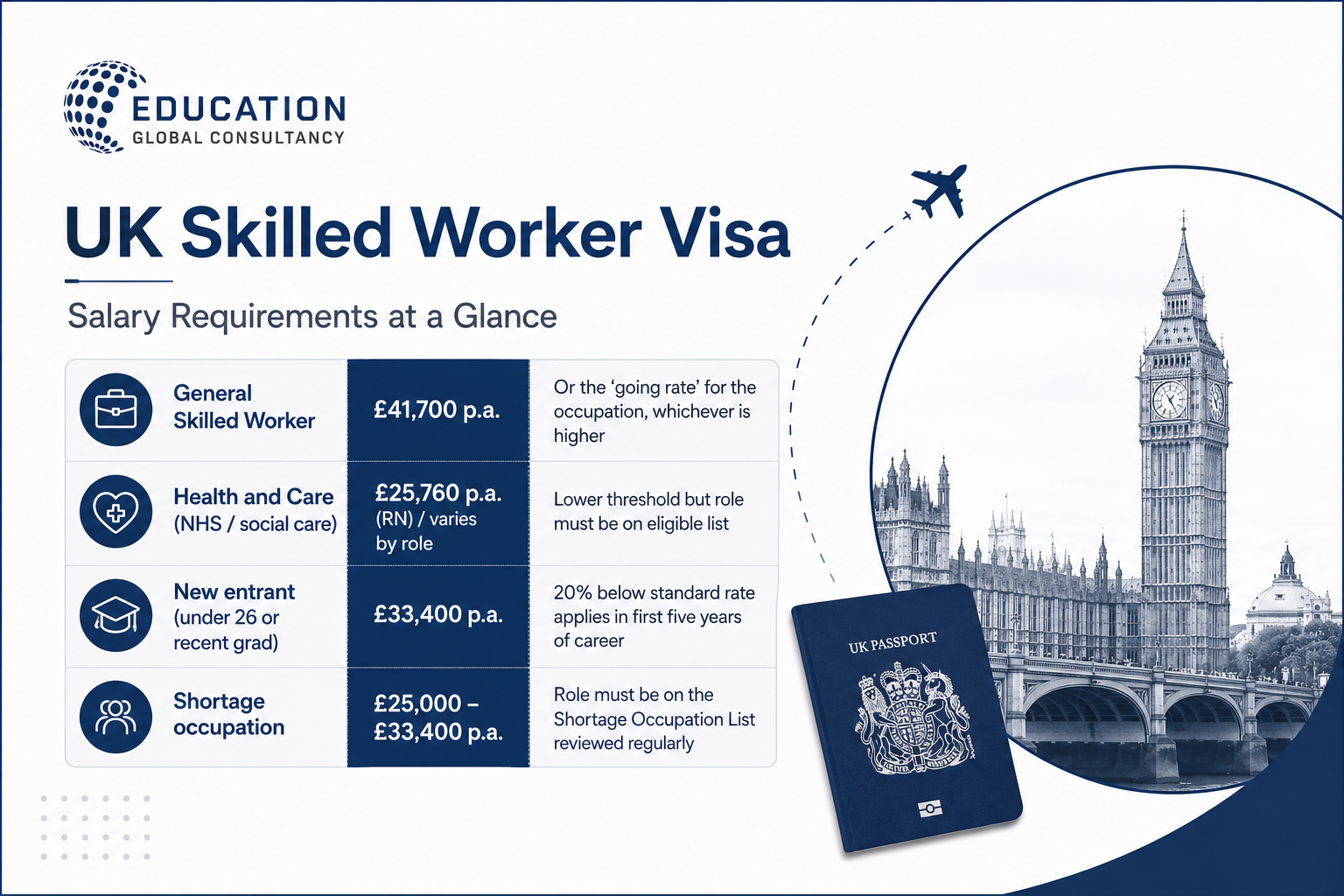
| Route | Minimum Salary (2026) | Notes |
| General Skilled Worker | £41,700 p.a. | Or the ‘going rate’ for the occupation, whichever is higher |
| Health and Care (NHS / social care) | £25760 p.a. (RN) / varies by role | Lower threshold but role must be on eligible list |
| New entrant (under 26 or recent grad) | £33,400 p.a. | 20% below standard rate – applies in first five years of career |
| Shortage occupation | £25000- £33400 p.a. | Role must be on the Shortage Occupation List – reviewed regularly |
The New Entrant rate (£33,400) is particularly relevant for Nepali graduates coming straight from their UK degree. If you are under 26 or are a recent graduate switching from the Graduate Route within five years of qualification, you may qualify for this lower threshold which is meaningfully more accessible for entry to mid-level roles.
4. English Language Requirement
The English language requirement for the Skilled Worker Visa is B1 level on the CEFR. For most Nepali graduates who studied in the UK, this is automatically met by the fact of having studied at a UK degree level – no separate language test is required in most cases. If you have been in the UK on the Graduate Route, your previous student visa language evidence is typically sufficient.
How to Find a Sponsoring Employer as a Nepali Graduate
Finding a Skilled Worker Visa sponsor during your Graduate Route years is the most critical task you will face as a Nepali graduate who wants to remain in the UK. Here is how to approach it strategically:
- Search the Home Office Sponsor Register before applying to employers – filter by your sector and region to identify which specific employers can sponsor you
- Target large employers first – large UK companies, NHS Trusts, multinational corporations, and major hospitality or logistics groups are more likely to hold Sponsor Licences than small businesses
- Be explicit at the right moment – do not ask ‘can you sponsor me?’ in an initial application. Raise it professionally at the offer stage or when the role reaches final selection
- Consider sectors with structural shortages – healthcare, IT, engineering, financial services, and social care all have ongoing demand for skilled workers and are more familiar with the sponsorship process
- Use LinkedIn proactively – connect with HR professionals and hiring managers at licensed sponsors in your target sector; many roles at sponsoring employers are filled through networks before formal advertising.
For broader support with your international education and career planning, explore our study abroad services.
The Pathway From Skilled Worker to ILR
With a Skilled Worker Visa in place, the pathway to Indefinite Leave to Remain (ILR) becomes clear. ILR requires five continuous years of lawful residence in the UK. The Graduate Route counts toward this from April 2024 meaning two years on Graduate Route plus three years on Skilled Worker can satisfy the five-year requirement, subject to meeting all other ILR conditions including absence rules, salary requirements, and no serious criminal record.
After ILR, British citizenship becomes available after a further 12 months bringing the full journey from student arrival to citizenship to approximately 7-10 years for most Nepali graduates who plan carefully.
Education Global’s Post-Study Career Support
Education Global supports Nepali students not just through their visa applications but through their UK career journey. We provide Skilled Worker Visa guidance, employer search strategy coaching, and ongoing immigration advice for graduates navigating the path from Graduate Route to ILR. Book a consultation