
For the September intake UK 2027, Nepali students should apply between now and January 2027. The UCAS undergraduate deadline is 13 January 2027 (18:00 UK time). Most master’s courses take applications until summer 2027, but popular courses and scholarships close much earlier. Your Student visa can be applied for up to six months before your course starts, once you have a CAS. Because every September 2027 visa application will be made after 30 November 2026, you should plan for the new, higher bank balance: £1,203 a month outside London or £1,570 a month in London (up to nine months), plus any unpaid first-year tuition. Why September is still the main UK intake September (sometimes late September or early October) is when most UK undergraduate and master’s courses start. It offers the widest course choice, the most scholarships and the longest settling-in period before exams. January intakes exist, but with fewer courses. Three things make planning for September 2027 different from previous years: Key deadlines for the September 2027 intake Date What happens Who it affects 1 September 2026 UCAS opened for 2027 entry Undergraduate applicants 15 October 2026 (passed) Deadline for Oxford, Cambridge and most medicine, dentistry and veterinary courses Undergraduate applicants to those courses 30 November 2026 Higher maintenance funds apply to visa applications made from this date All Student visa applicants 13 January 2027, 18:00 UK time UCAS equal-consideration deadline for most courses Undergraduate applicants January–July 2027 Most master’s applications close; dates vary by university and course Postgraduate applicants About 6 months before your course start Earliest date to apply for your Student visa All Student visa applicants Summer 2027 Clearing for undergraduate places still open Late undergraduate applicants Master’s deadlines vary widely. As one example, the University of Sheffield opened September 2027 postgraduate applications on 15 September 2026. Its last date for applicants who need a visa is 26 August 2027, and it suggests requesting your CAS by 6 September 2027. Treat these as the latest possible dates, not targets. Competitive courses and scholarships fill months earlier. Month-by-month timeline from Nepal The plan below works backwards from a late-September 2027 start. Adjust it to your university’s exact dates. When Undergraduate (after +2) Master’s (after bachelor’s) Nov–Dec 2026 Shortlist universities, book IELTS/PTE, write personal statement, get references Shortlist courses, book IELTS/PTE, write SOP, request transcripts and references By 13 Jan 2027 Submit UCAS application Apply early to popular courses and scholarship-linked offers Jan–Apr 2027 Receive offers, reply to UCAS, check scholarships Receive offers, apply for scholarships, accept your firm choice Apr–Jun 2027 Meet offer conditions, pay deposit, complete credibility interview Meet conditions, pay deposit, complete credibility interview May–Jun 2027 Put full bank balance in place and start the 28-day count Same Jun–Jul 2027 Receive CAS; book TB test Receive CAS; book TB test Jul–Aug 2027 Apply for Student visa (usually decided within 3 weeks) Same Late Aug–Sep 2027 Travel (up to 1 month before course start) Same Undergraduate students (after +2) Apply through UCAS by 13 January 2027 for equal consideration. After that date, universities only consider you if places remain. Entry rules for Nepali +2 (NEB) students vary by university. Some offer direct entry with strong grades. Others, such as the University of Exeter, ask students with Nepal school qualifications to complete a foundation programme first. Check each university’s Nepal country page before you apply. Master’s students Most UK master’s courses use rolling admissions, so earlier is better. Universities usually expect a four-year bachelor’s degree from Nepal, though some accept three-year degrees with extra study. For example, Exeter accepts a four-year degree and lists 65% (CGPA 3.0/4) as the equivalent of a UK 2:1. It also lists a £10,000 postgraduate taught scholarship for Nepali students starting in September 2027, applied automatically to eligible offers. The CAS: your real starting gun You cannot apply for your Student visa without a Confirmation of Acceptance for Studies (CAS) from your university. Universities usually issue a CAS only after you have: Many universities issue September CAS numbers from around June. Sheffield, for example, starts CAS processing in June 2027. If your CAS is delayed, read our guide on what to do while waiting for your CAS. Bank balance and visa costs for September 2027 All September 2027 visa applications will use the higher maintenance amounts introduced by HC 584. Cost (2027 applications) GBP Approx. NPR* Living costs, outside London (9 × £1,203) £10,827 NPR 21.98 lakh Living costs, London (9 × £1,570) £14,130 NPR 28.68 lakh Student visa fee (outside UK) £558 NPR 1.13 lakh IHS, 1-year master’s (visa over 1 year, up to 18 months) £1,164 NPR 2.36 lakh IHS, 3-year degree (visa about 3 years 4 months) £2,716 NPR 5.51 lakh TB test, Norvic International Hospital NPR 7,800 NPR 7,800 *Converted at the Nepal Rastra Bank GBP selling rate of NPR 202.99 (17 October 2026). Rates change daily; recheck before transferring money. You must also show any first-year tuition still unpaid on your CAS. The Immigration Health Surcharge (IHS) is £776 per year for students, charged on the length of your visa, not your course. The 28-day rule Your money must be held for 28 consecutive days, and the end of that period must fall within 31 days of your visa application. If you top up your account partway through, the 28-day count normally restarts at the new balance. Example: if you apply on 15 July 2027, your 28-day period must end on or after 14 June 2027. Holding the full amount from mid-May 2027 to your application date keeps you safe. For more detail on accepted accounts and loans, see our UK Student visa cost guide. TB test in Nepal Students applying from Nepal need a tuberculosis (TB) test certificate from a Home Office-approved clinic. The certificate is valid for 6 months from your chest X-ray. Clinic Location Fee (age 11+) IOM Migration Health Assessment Center Lazimpat, Kathmandu USD 60 (paid in NPR) IOM Resettlement Health Assessment Centre Damak, Jhapa USD 60 (paid in NPR) Norvic International
Australia February Intake 2027: Deadlines, Visa Timeline and Tips for Nepali Students
Australia February intake 2027 applications are open now, and Nepali students who want to start studying in Australia next year still have time. The window is short, though. Many universities begin teaching on or around 1 March 2027. Some close international applications as early as 15 December 2026, while others accept bachelor’s and postgraduate applications until early March 2027. To make the Australia February intake 2027 work, you realistically need an offer, a Confirmation of Enrolment (CoE) and a lodged visa by January 2027. Visa refusal rates for Nepali applicants rose sharply in 2026, and several rules changed on 2 October 2026. This guide brings together verified dates, costs and visa rules so you can decide whether February or July 2027 suits you. What is the Australia February intake 2027? The Australia February intake 2027 is Semester 1 (or Trimester 1) of the 2027 academic year. Australia’s academic year follows the calendar year, so the February intake is usually the largest of the year. More courses are typically open to new international students than in the July intake. The word “February” can be a little misleading. Most universities start teaching in late February or early March, with orientation the week before. For example: In practice, most university students on the Australia February intake 2027 will fly out in mid-to-late February. If you miss it, the next main intake is July 2027. RMIT’s higher education Semester 2 begins on 19 July 2027, and Deakin’s Trimester 2 begins on 5 July 2027. Australia February intake 2027 key dates and deadlines Each university sets its own application deadline. The government does not set them. The dates below were checked on official university pages on 26 October 2026. Always confirm the dates on your own course page, because some courses close earlier. University International application deadline Offer acceptance deadline Classes start ANU (Canberra) 15 Dec 2026 (Crawford School programs: 31 Oct 2026) 15 Jan 2027 if you are overseas Semester 1 2027 (check ANU) RMIT (Melbourne): bachelor’s and postgraduate coursework 3 Mar 2027 5 Mar 2027 1 Mar 2027 RMIT: Certificate IV, diploma, advanced diploma 10 Feb 2027 12 Feb 2027 8 Feb 2027 RMIT: Foundation Studies (Fast Track) 25 Jan 2027 27 Jan 2027 Check RMIT Deakin (Melbourne, Geelong) Check your course page Check your course page 1 Mar 2027 A late official deadline does not mean you should apply late. RMIT advises student-visa applicants to apply and accept an offer at least 4 to 8 weeks before the course starts so the visa can be processed. Nepali applicants should allow more time than that, because files from Nepal are checked closely. Why early deadlines matter more for Nepali students Your university may run its own Genuine Student check or interview before it issues a CoE. You then need time to gather financial evidence, buy health cover and wait for Home Affairs. That is why applying for the Australia February intake 2027 in November 2026 is much safer than applying in late January. Your Australia February intake 2027 timeline, step by step This is a recommended planning timeline, not an official government schedule. Work backwards from your course start date. When What to do Late Oct to mid Nov 2026 Shortlist 3 to 5 courses. Book IELTS, PTE or TOEFL if you don’t have a valid score. Collect transcripts, character certificate, work letters and passport. November 2026 Submit university applications. Start your Genuine Student (GS) answers and financial documents. Late Nov to Dec 2026 Receive offers. Complete any university GS or credibility interview. Finalise your funds and sponsors. Dec 2026 to early Jan 2027 Accept your offer, pay the tuition deposit, buy Overseas Student Health Cover (OSHC) and receive your CoE. Early to mid Jan 2027 Lodge your Student visa (subclass 500) online with your CoE, GS answers, funds evidence, English results and OSHC. Complete health checks and biometrics if asked. Late Jan to Feb 2027 Receive the visa outcome, book flights and accommodation, and arrive for orientation. If you cannot lodge a complete visa application by mid-January 2027, think seriously about the July 2027 intake. A rushed application with weak financial or GS evidence is one of the most common reasons for refusal. What the 2027 National Planning Level means for you On 15 July 2026, the Australian Government confirmed the 2027 National Planning Level (NPL) at 295,000 new overseas student commencements. That is the same figure as 2026. The government says clearly that the NPL is not a cap on student numbers. It works like this: What this means for you: at popular universities, students who lodge early for the Australia February intake 2027 are more likely to get faster, priority processing. It is one of the strongest reasons to apply now rather than in January. Australian student visa rules that changed in 2026 Many older blog posts about the Australia February intake are now out of date. These are the most important 2026 changes for Nepali applicants. 1. Visa fee is now AUD 2,500 The Student visa application charge rose from AUD 2,000 to AUD 2,500 for applications lodged on or after 1 July 2026. The fee is not refunded if your visa is refused. The Kathmandu Post estimated this at about Rs 260,000. 2. Family members generally can’t be included (from 2 October 2026) For applications lodged on or after 2 October 2026, you generally cannot include a spouse or children in your Student visa. Family members also cannot be added after the visa is granted. Exemptions include doctoral students, holders of fully funded foreign-government scholarships, and students sponsored by DFAT or the Department of Defence. See the official October 2026 update for the full list. 3. Apply and be granted outside Australia If you apply from Nepal, you must also be outside Australia when the visa is granted. Most other temporary visa holders can no longer switch to a Student visa from inside Australia. 4. Changing provider will need a new “Transfer stream” Australia plans a new
Cost of Studying in Australia from Nepal 2027: Tuition, Living Costs and Visa Budget in NPR
Cost of studying in Australia from Nepal for (February or July 2027), most Nepali students should plan for AUD 55,000–85,000 for the first year (roughly NPR 59–91 lakh), depending on the course and city. That covers one year of tuition, the AUD 29,710 living-cost amount the Australian Government uses for visa purposes, the AUD 2,500 student visa charge and health cover. The four costs that matter most: What changed for 2026–27 budgets Three updates affect anyone planning a 2027 intake: The living-cost figure of AUD 29,710 has applied since 10 May 2024, and no change has been announced for 2027 at the time of writing. Tuition fees in Australia for Nepali students (2026 examples) Australian fees vary widely by university, course and city, and the government’s Study Australia site does not publish a single range. The table shows real 2026 fees from one large Melbourne university so you can see the scale. Always check your own course page. Course (RMIT, 2026) Fee (AUD) Approx. NPR Bachelor of Engineering (Electrical, Honours), per year 47,040 50.1 lakh Bachelor of Education (Primary and Secondary), per year 36,480 38.9 lakh Master of Finance, per year 48,960 52.2 lakh MBA, per year 50,880 54.2 lakh Graduate Certificate in Project Management, total 24,960 26.6 lakh Diploma of Information Technology, total course 25,250 26.9 lakh Two things to remember. Fees usually rise each year, so a two-year master’s will cost more in year two. And vocational diplomas and graduate certificates can be a lower-cost entry point, though they bring different post-study work options. Living costs in Australia The visa amount: AUD 29,710 For the Student visa, the Australian Government uses AUD 29,710 as the 12-month living cost for a student. If family members come with you, add AUD 10,394 for a partner and AUD 4,449 for each child, plus AUD 13,502 a year for each school-age child. What students actually spend Real costs depend heavily on your city and how you live. RMIT estimates AUD 30,000–45,000 a year for Melbourne in 2026, which is above the visa figure. Its weekly estimates per person: Weekly cost (Melbourne, RMIT 2026 estimate) AUD Food and eating out 150–250 Public transport 30–60 Phone and internet 15–30 Gas and electricity 10–20 Entertainment 30–150 Rent is the biggest variable. The median weekly rent for a one-bedroom flat in metropolitan Melbourne was AUD 500 (September 2025 data, cited by RMIT). Sharing a house, or choosing a smaller city such as Adelaide or Hobart, usually brings this down. Visa and health cover costs Cost AUD Approx. NPR Notes Student visa (subclass 500), main applicant 2,500 2.66 lakh From 1 July 2026; family members pay extra OSHC, single (per year, RMIT estimate) 590–750 63,000–80,000 Must cover your whole visa period, so you usually pay for the full course upfront Health check, biometrics, English test Varies Varies Check current Nepal fees with the provider Basic OSHC covers GP visits, hospital treatment, ambulance and some medicines. It does not cover dental or optical care unless you buy extras. Sample first-year budgets in NPR These worked examples use RMIT 2026 fees, the AUD 29,710 visa living-cost figure and the top of RMIT’s OSHC estimate. They exclude flights and one-off setup costs such as a rental bond. Item Bachelor of Engineering (AUD) Master of Finance (AUD) Tuition, first year 47,040 48,960 Living costs (visa figure) 29,710 29,710 OSHC (one year) 750 750 Student visa 2,500 2,500 Total (AUD) 80,000 81,920 Total (approx. NPR) 85.2 lakh 87.3 lakh A lower-fee university or a regional campus can bring the total down a lot. Budget extra if you plan to live in Sydney or inner Melbourne. How much bank balance do you need for an Australian student visa? When you are asked to show financial capacity, you generally need enough for: For the Master of Finance example, that is AUD 78,670 before travel (about NPR 83.8 lakh). Some applicants can instead show the annual income of a parent or partner; secondary sources put this at AUD 87,856 a year for a single student, but confirm the current figure in the official Home Affairs Document Checklist Tool. Whether you must upload financial evidence when you apply depends on your country and education provider. Use the Document Checklist Tool on the Home Affairs website, and remember that funds must be genuinely available to you. Education Global counsellors can review your sponsor documents before you lodge. Can part-time work cover your costs? Student visa holders can work up to 48 hours per fortnight during study periods and unlimited hours during scheduled course breaks. At the 2026 minimum wage of AUD 26.44 an hour, 48 hours is about AUD 1,269 a fortnight before tax (about NPR 1.35 lakh). That can help with rent and food, but it will not pay tuition, and it cannot be counted as visa funds. Plan to arrive with your first year fully funded. When to start saving: 2027 intake timeline Step February 2027 intake July 2027 intake Shortlist courses, take IELTS/PTE Now (October 2026) Now to January 2027 Apply and get your offer October–November 2026 January–March 2027 Pay deposit and OSHC, get your CoE November–December 2026 March–April 2027 Lodge Student visa (AUD 2,500) As soon as you have your CoE As soon as you have your CoE Move funds and book flights After visa grant After visa grant University deadlines vary, and late-semester applications can take longer to process because of the planning-level system. Earlier is safer. Cost checklist for Nepali students FAQs How much does it cost to study in Australia from Nepal per year? Most students need AUD 55,000–85,000 for the first year (about NPR 59–91 lakh), including tuition, the AUD 29,710 living-cost figure, the visa and OSHC. Your exact cost depends on course, university and city. What is the Australian student visa fee in 2026? The standard Student visa (subclass 500) charge is AUD 2,500 from 1 July 2026, up from AUD 2,000. Family members included in the application pay additional charges. How much living cost do I
UK Student Dependant Visa: Can You Bring Your Family to the UK While Studying?
In recent months, we have received many enquiries from international students who want to bring their spouse, partner, or children to the UK while pursuing higher education. For many students, studying abroad is not just about building a career; it is also about creating a better future for their families. However, the UK Student Dependant Visa rules have changed, and not every international student is eligible to bring their family members to the UK. Therefore, it is important to understand the current requirements before making any plans. At Education Global Consultancy, we understand how important family is when planning your education abroad. In this blog, we explain the main rules in simple terms so you can better understand your options. 1. Who Can Bring Dependants to the UK? First of all, eligibility depends on the type of course you are studying, when your course started, and whether you meet the relevant immigration requirements. Under the current UK student visa rules, international students generally fall into the following categories. Students starting courses on or after 1 January 2024 If your course started on or after 1 January 2024, you can generally bring your dependants only if you meet one of the following conditions: In other words, most international students studying ordinary taught master’s programmes cannot bring their spouse or children to the UK as student dependants under these rules. What about students who started before 1 January 2024? The rules were different for eligible students whose courses started before 1 January 2024. For example, certain students studying full-time postgraduate courses lasting nine months or longer could bring their eligible family members. Government-sponsored students could also qualify under the applicable rules. Importantly, eligible students who started taught postgraduate courses before 1 January 2024 may still be able to have their dependants join them later, provided they meet the relevant requirements. However, the course start date alone does not guarantee eligibility. Your individual circumstances and the applicable immigration rules must also be considered. 2. Who Counts as a Dependant? Under the UK student visa route, eligible dependants generally include: You must provide the required evidence to demonstrate your relationship and meet the relevant visa conditions. Additionally, financial requirements and other documentation may apply, depending on your circumstances. 3. Can Students on a Taught Master’s Programme Bring Their Families? This is one of the most common questions we receive from international students. The answer is that most students starting a standard taught master’s programme on or after 1 January 2024 cannot bring dependants under the student visa route, unless they qualify under an applicable exception. For instance, enrolling in a Master’s programme does not automatically make you eligible to bring your spouse or children. The distinction between a taught master’s degree and a qualifying research-based higher degree is particularly important. According to the UK immigration rules, a research-based higher degree must have a research component, including the requirement to produce original work, that is greater than the taught component when measured by student effort. Therefore, before accepting an offer from a university, students who plan to bring their families should carefully check whether their chosen course meets the relevant requirements. 4. What If Your Family Members Are Already in the UK? Another common question concerns dependants who are already living in the UK. In certain circumstances, existing student dependants may be able to extend their permission to stay. However, eligibility depends on their current immigration status and the applicable rules. It is therefore important not to assume that the rules for extending an existing visa are identical to those for bringing a new dependant to the UK. If your spouse or children are already in the UK, check the relevant requirements before submitting an extension application. 5. What Documents May Be Required? If you are eligible to apply for a student dependent visa, you may need to provide supporting documents such as: The exact requirements may vary depending on your circumstances. Therefore, always consult the official UK government guidance before applying. You can find the latest information on the official UK government website – Student Visa Family Members. 6. Do Not Forget About Family Accommodation If your dependants are eligible to join you in the UK, accommodation is another important factor to consider. Finding suitable housing for a family can be more difficult and expensive than finding accommodation for a single student. University halls of residence may not offer suitable facilities for families, and private accommodation can require additional planning. For this reason, it is sensible to research housing options before travelling. You should also consider living costs, childcare arrangements where applicable, and the practical needs of your family. Planning ahead can help you avoid unnecessary stress once you arrive in the UK. 7. Why Should You Check Your Eligibility Before Applying? With so many students asking about dependent visas, it is understandable that confusion can arise, particularly when immigration rules change. However, choosing a course or submitting a visa application without checking the requirements may lead to disappointment, delays, or additional expenses. Before making a decision, consider the following questions: Answering these questions can help you understand which rules may apply to your circumstances. How Education Global Consultancy Can Help At Education Global Consultancy, we understand that planning your education in the UK involves more than choosing a university. For students with families, understanding dependant visa eligibility is an equally important part of the process. Our team can help you understand the general requirements, identify the key questions to consider, and direct you towards the relevant official guidance before you make your next move. Every student’s situation is different, so it is important to review your circumstances carefully rather than rely on information shared by friends, social media, or other students. Planning to Study in the UK With Your Family? If you are an international student planning to study in the UK and want to understand whether your spouse or children may be eligible to join you, contact Education Global Consultancy for
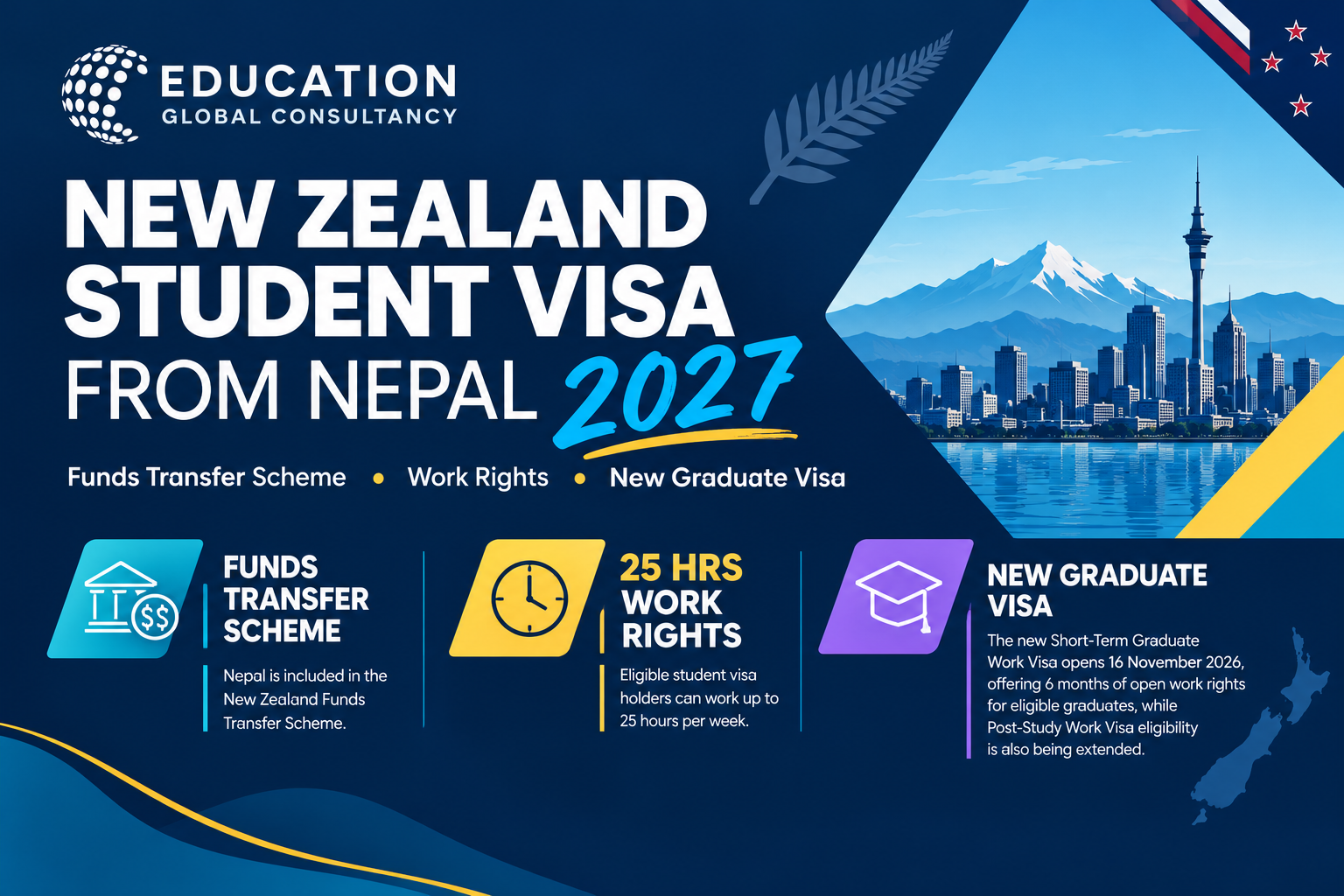
New Zealand Student Visa from Nepal 2027: Funds Transfer Scheme, Work Rights and the New Graduate Visa
To get a New Zealand student visa from Nepal for 2027, you need these things: The visa costs from NZD 850. Since 2 April 2026, most Nepali students approved in principle must move their living funds through Immigration New Zealand’s Funds Transfer Scheme. Once you arrive, you can work up to 25 hours a week during term. From 16 November 2026, a new 6-month graduate work visa and a wider Post-Study Work Visa open up more options after study. Nepal’s approval rate was 52% in 2025, so a careful, well-evidenced application matters. What’s new for Nepali students in 2026–27 Four changes shape the 2027 intakes for Nepali applicants. Most of them are not covered in older guides. Change Date What it means for you Nepal added to the Funds Transfer Scheme (FTS) From 2 April 2026 Most Nepali students approved in principle must deposit their living funds into an FTS account with a New Zealand bank before the visa is finalised. Student work rights raised from 20 to 25 hours a week Visas granted from 3 November 2025 More part-time income during term, and full-time work in scheduled holidays (subject to visa conditions). New Short-Term Graduate Work Visa (6 months) Opens 16 November 2026 Graduates of eligible Level 5–7 qualifications who can’t get a Post-Study Work Visa now have 6 months of open work rights. Post-Study Work Visa extended to Level 7 graduate diplomas From 16 November 2026 If you already hold a bachelor’s degree (from Nepal or anywhere else), a NZ graduate diploma can now lead to a PSWV of up to 1 year. Nepal’s approval rate: why preparation matters In 2025, Immigration New Zealand (INZ) decided 1,957 offshore student visa applications from Nepal. It approved 1,024 (52%) and declined 918 (47%). Across all countries, the approval rate was 83% (INZ data as of 16 February 2026). That gap doesn’t mean New Zealand is closed to Nepali students. It means INZ looks closely at three things: whether you are a genuine student, where your money comes from, and whether your course fits your background. Most declines can be avoided with a clear study plan and clean financial evidence. New Zealand student visa requirements from Nepal (2027) The Fee Paying Student Visa is the main visa for full-time international students. It can be issued for up to 4 years and usually covers the period of study you have paid for. 1. Offer of place Your offer must come from an approved education provider that has signed the Education (Pastoral Care of Tertiary and International Learners) Code of Practice 2021. It must show: You can apply with a conditional offer from outside New Zealand. You will need an unconditional offer before the visa is approved. 2. Tuition fees You must show that you have paid tuition for one year, or for the whole course if it is shorter. INZ accepts payment receipts or confirmation from your provider. It does not accept screenshots of bank transfers or receipts from education agents. 3. Living costs (maintenance funds) The money can be your own, or it can come from a sponsor or guarantor. Nepal-specific rule: for applicants from Nepal applying in South Asia, only immediate family can sponsor you or sign a financial undertaking. That means a partner, parents, siblings, grandparents or parents-in-law. 4. English language INZ does not require an English test for the visa itself. Instead, your provider must confirm you have the English and academic ability to pass your course. Universities set their own IELTS, PTE or TOEFL minimums for each programme, so check your offer conditions. A good score also supports your case as a genuine student. 5. Health, character and insurance How the Funds Transfer Scheme works for Nepali students The FTS is the biggest new step for Nepali applicants in 2026–27. Here is how it runs: INZ says the scheme shows you have real access to your money, and it expects the scheme to speed up processing for Nepal. It does not guarantee approval. You can get a refund if your visa is declined. Tip: have the full amount ready and traceable before you apply, because 15 days is not long for an international transfer. How much money you need: a budget checklist Your exact total depends on your course. Use your offer letter for tuition and these official minimums for the rest. Item Amount Notes Tuition (year 1, or the full course if shorter) As per your offer letter Must be paid before the visa is finalised Living costs NZD 20,000 per year (NZD 1,667 per month if under 1 year) Moved through the FTS for most Nepali applicants Outward travel A paid ticket or the equivalent funds Required by INZ Student visa application From NZD 850 Check the INZ fee finder when you apply Health and travel insurance Varies by provider and policy Must cover the whole visa period Medical (chest X-ray) and police certificate Varies in Nepal Use INZ-approved panel clinics INZ also checks where the money came from. It accepts bank statements covering the last 3 months, fixed deposits held for at least 3 months, and education loans from a nationalised or multinational bank. Be ready to explain any large deposit over NZD 2,000, and keep proof of income such as tax returns, salary slips, business registration or rental income. 2027 intakes and when to apply Most universities have two main intakes: Semester One (February/March) and Semester Two (July). Some polytechnics and private providers offer more start dates. Intake Typical start Admission deadline (example) Visa timing Semester One 2027 February/March 2027 University of Auckland undergraduate: 1 July 2026 to 31 January 2027, by programme (Nursing international: 1 Nov 2026) INZ advised applying around September 2026. Apply now if you haven’t. Semester Two 2027 July 2027 University of Auckland undergraduate international: 8 June 2027 Apply at least 3 months before travel, so by about March–April 2027 INZ’s busiest months are October to March, and applications from Nepal and other South Asian countries can take
US Student Visa from Nepal 2027: F-1 Rules, Fees and Interview Guide
If you are applying for a US student visa from Nepal for Spring or Fall 2027, the core process has not changed: get an I-20 from an SEVP-approved university, pay the $350 SEVIS fee and the $185 visa application fee, and pass an F-1 interview at the US Embassy in Kathmandu. What has changed is the scrutiny. Nepali F-1 refusals rose to 81% in 2025, your social media must be set to public, and a new rule ending “duration of status” was paused by a US court on 14 September 2026 — but could return. Preparation now matters more than ever. What changed for US student visas in 2026–27 Four developments affect Nepali students planning to start in 2027. 1. The “duration of status” rule: published, then paused On 17 July 2026, the US Department of Homeland Security (DHS) published a final rule to replace “duration of status” (D/S) for F-1 students with a fixed admission period. It was due to start on 15 September 2026. Under the rule: On 14 September 2026, a US federal court in Massachusetts postponed the rule while a legal challenge continues. For now, F-1 students keep D/S, there is no fixed “admit until” date, and the 60-day grace period still applies. What this means for you: Nothing changes today, but the rule could take effect later if the government wins its case. Choose a programme you can realistically finish on time, and avoid plans that rely on switching course or level after you arrive. 2. Nepal’s F-1 refusal rate jumped State Department data, obtained and analysed by Shorelight and reported by ICEF Monitor in April 2026, shows Nepali F-1 refusals rose from 59% in 2024 to 81% in 2025. The global F-1 refusal rate was 35% in 2025, up from 31% in 2024. At the same time, Nepali enrolment in the US grew by 48% in 2024/25. High demand plus tighter checks means officers are looking hard at every file. 3. Public social media and stricter vetting Since June 2025, the US Department of State has told all F, M and J applicants to set the privacy settings on all their social media profiles to “public”. The US Embassy in Nepal repeats this instruction. Officers can review your online presence against what you say in your DS-160 and interview. 4. Apply in Nepal The State Department says non-immigrant visa applicants should book their interview at the US Embassy or Consulate in their country of nationality or residence. For most Nepali students, that means the US Embassy in Kathmandu, booked through the official scheduling site. What has not changed Some headlines have caused confusion. As of 7 October 2026: US student visa costs from Nepal (2026–27) Cost Amount (USD) When you pay Notes SEVIS I-901 fee $350 After receiving your I-20, before the interview Paid online to US Immigration and Customs Enforcement Visa application (MRV) fee $185 Before booking your interview Non-refundable; valid 365 days from payment Visa integrity fee $250 (if collected) At visa issuance Set by a 2025 US law; collection has been uneven across embassies — confirm with the US Embassy in Nepal Proof of funds First-year cost on your I-20 Shown at the interview Tuition plus living costs as calculated by your university Fees are correct as of 7 October 2026 and can change. Always check the official fee pages before paying. Why Nepali students get refused: Section 214(b) Most F-1 refusals are issued under Section 214(b) of US immigration law. The officer must presume you intend to immigrate unless you show otherwise. Common reasons in Nepali cases include: A 214(b) refusal is not permanent. You can reapply, but only when something real has changed — a stronger university choice, clearer funding, or a better-prepared explanation. 2027 intake timeline for Nepali students Deadlines vary by university, so treat this as a planning guide. Milestone Spring 2027 (January start) Fall 2027 (August/September start) Shortlist universities and take IELTS/TOEFL/PTE/Duolingo (as accepted) Should be done by now October–December 2026 Submit applications Most deadlines have passed; some rolling admissions remain November 2026–February 2027 (earlier for scholarships) Receive admission and I-20 October–November 2026 February–May 2027 Pay SEVIS fee and complete DS-160 As soon as the I-20 arrives As soon as the I-20 arrives Visa interview in Kathmandu October–December 2026 April–July 2027 Earliest entry to the US 30 days before your programme start date 30 days before your programme start date The State Department allows F-1 visas to be issued up to 365 days before your course starts, but you cannot enter the US more than 30 days before the start date on your I-20. Step-by-step: applying for a US student visa from Nepal Interview checklist: questions to practise Keep answers short, honest and specific. Officers often decide within a few minutes, so clarity beats memorised speeches. Frequently asked questions Is the US still a good option for Nepali students in 2027? Yes, for students with a strong profile and a clear plan. The US offers wide programme choice and OPT after graduation, but refusals are high, so preparation is essential. Will the duration of status rule affect me? Not at the moment. A US court postponed it on 14 September 2026. If it returns, it would apply fixed admission periods of up to four years. Your counsellor should check the latest position before you travel. How much bank balance do I need for a US student visa from Nepal? There is no single fixed figure. You need to show funds that cover at least the first-year cost listed on your I-20, from sources you can explain. Do I need to pay the US visa bond as a student? No. As of 7 October 2026, the visa bond pilot that includes Nepal applies to B-1/B-2 visitor visas, not F-1 student visas. Can I reapply after a 214(b) refusal? Yes. There is no fixed waiting period, but you should reapply only when your circumstances or preparation have meaningfully improved. Do I have to make my social media
Canada Student Visa from Nepal 2027: New Funds Rule, Study Permit Cap and Step-by-Step Guide
To get a Canada student visa from Nepal for a 2027 intake, you need an acceptance letter from a Designated Learning Institution (DLI), usually a Provincial or Territorial Attestation Letter (PAL/TAL), and proof that you can pay your first-year tuition plus CAD 23,448 for living costs (for one person, outside Quebec) and travel. That living-cost figure applies to applications from 1 September 2026, up from CAD 22,895. Canada is also capping new study permits: the government’s plan targets 150,000 new student arrivals in 2027, and the official 2027 cap is expected to be set this autumn. Strong, well-documented applications matter more than ever. If you are a Nepali student planning a January, May or September 2027 start, this guide explains what changed in 2026, how much money you need to show, who needs a PAL, your work rights, and a practical checklist to avoid refusal. What has changed for Canadian study permits in 2026? Several rules now shape every study permit application from Nepal. Here is a summary of the most important ones, with the year each applies. Change What it means for you Applies from Higher proof of funds Living costs for one person rise to CAD 23,448 (was CAD 22,895) Applications from 1 Sep 2026 Study permit cap continues 309,670 application spaces and 155,000 new-arrival target for 2026; 150,000 new arrivals planned for 2027 2026 cap year; 2027 cap due with the next Levels Plan PAL exemption for master’s/PhD Master’s and doctoral students at public DLIs no longer need a PAL/TAL 1 Jan 2026 PAL tied to cap year A PAL issued for 2026 is valid only until 31 Dec 2026 and can’t be reused for a new cap year 2026 cap year onward Off-campus work limit Up to 24 hours per week during academic sessions; unlimited in scheduled breaks Current rule (2026) Spouse work permits narrowed Mostly limited to spouses of master’s (16+ months), PhD and certain professional-degree students 21 Jan 2025 Student Direct Stream closed No faster “SDS” route; all Nepali applicants use the regular study permit process Closed 8 Nov 2024 Is Canada still a good option for Nepali students in 2027? Yes, for the right student and the right program — but it is more selective than it was a few years ago. Canada plans fewer new international students (155,000 in 2026 and 150,000 in each of 2027 and 2028, under its 2026–2028 Immigration Levels Plan). IRCC also reported that the refusal rate for new study permits was 62% as of 31 January 2026 (all nationalities). That does not mean you should give up on Canada. It means you need a clear study plan, genuine funds and a program that makes sense for your background and career goals. Students choosing master’s or doctoral programs at public universities have one big advantage: they skip the PAL step entirely. How much money do you need for a Canada student visa from Nepal? You must show enough money for three things: your first-year tuition, your living expenses, and return transportation. IRCC’s living-expense amounts for study outside Quebec are below. Proof of funds for living costs (applications from 1 September 2026) People applying (including you) Living costs required (CAD, 2026) 1 (you only) 23,448 2 29,192 3 35,888 4 43,572 Each additional person +6,318 IRCC adjusts this figure every year on 1 September, so check again if you apply after 31 August 2027. Quebec has its own, separate financial requirements. A worked example Suppose your college’s first-year tuition is CAD 18,000 (an illustrative figure — check your offer letter). If you travel alone, you would need to show at least: That is more than CAD 41,448 before flights. Convert to Nepali rupees using the current exchange rate when you prepare your file, and leave a buffer for rate changes. What counts as proof of funds? IRCC accepts documents such as: For Nepali families, officers look closely at where the money came from. Sudden large deposits without explanation are a common red flag. Keep clear records of income, property, business earnings or education loans that explain your balance. Do you need a Provincial Attestation Letter (PAL)? Most students need a PAL or TAL — a letter from the province or territory confirming you have a place under the national cap. Your college or university requests it for you after you accept your offer. You do not need a PAL/TAL if you are: Bachelor’s, diploma, postgraduate certificate and private-institution students usually still need one. A PAL is linked to its cap year, so a 2026 PAL cannot be used for a 2027 cap-year application. Canada intakes and when to apply for 2027 Canadian colleges and universities mainly offer three intakes. The timings below are general planning guidance; always follow your institution’s published deadlines. Intake Classes usually start Start applying to schools Aim to lodge your study permit January 2027 (Winter) January Already late — check remaining seats now As soon as you receive your LOA and PAL May 2027 (Summer) May October–December 2026 January–February 2027 September 2027 (Fall) September November 2026–February 2027 March–May 2027 Start early for the September intake. It has the widest choice of programs, but provincial PAL allocations can run out at some institutions. English test requirements IRCC does not set one IELTS, PTE or TOEFL score for a study permit. Your college or university sets the English requirement, and you must meet it to receive your letter of acceptance. Check each program’s page for the exact band score. Think ahead to work after graduation too. To get a Post-Graduation Work Permit (PGWP), you will need Canadian Language Benchmark (CLB) 7 in all four skills for a university degree, or CLB 5 for a college program, using an IRCC-approved test. Can you work while studying in Canada? Yes. If you meet the conditions, you can work off campus without a separate work permit: You must be a full-time student at a DLI, enrolled in a program of at least 6 months that leads to a degree,
What is changing with the UK Graduate visa?
The Graduate visa (also called the Graduate Route or post-study work visa) lets you stay and work in the UK after you finish an eligible degree. From 1 January 2027, the length of the visa depends on when you apply. Your qualification Apply on or before 31 Dec 2026 Apply on or after 1 Jan 2027 Bachelor’s degree 2 years 18 months Master’s degree (taught or research) 2 years 18 months PhD or other doctoral qualification 3 years 3 years Source: GOV.UK – Graduate visa; confirmed by UKCISA. What stays the same: Which Nepali students are affected? Most Nepali students who start UK courses from now on will get 18 months. The group that can still secure 2 years is small, and the window is short. Your situation Likely Graduate visa length What to do Finished a degree in summer 2026 and completion already confirmed 2 years Apply now, before your Student visa ends One-year master’s started September 2025, finishing September–December 2026 2 years only if completion is confirmed and you apply by 31 Dec 2026 Ask your university when results and completion will be reported to the Home Office Master’s started January 2026, finishing around January 2027 18 months Plan your job search for an 18-month window Starting a UK course in January 2027 or September 2027 18 months Factor 18 months into your cost and career planning PhD students (any intake) 3 years No change These are typical timelines. Your exact position depends on your course end date, when your university reports your completion, and the end date on your eVisa. Check all three with your university’s international student advice team. Can you apply before 31 December 2026 to get 2 years? Yes, but only if your university has already confirmed your completion to the Home Office. You cannot apply early just to beat the deadline. GOV.UK says you can apply once your university reports completion, without waiting for your graduation ceremony or certificate. (GOV.UK) Checklist for students finishing in late 2026: GOV.UK says decisions usually take about 8 weeks after you apply and prove your identity. You can keep working under your Student visa conditions while you wait, so check those conditions with your university before taking on extra hours. How much does the UK Graduate visa cost in 2026? The application fee is £937. You also pay the Immigration Health Surcharge (IHS), usually £1,035 per year of your visa. (GOV.UK) Visa length Application fee IHS Total 18 months (apply from 1 Jan 2027) £937 £1,552.50 £2,489.50 2 years (apply by 31 Dec 2026) £937 £2,070 £3,007 3 years (PhD) £937 £3,105 £4,042 Totals match the figures published by the University of Leeds. Fees and the IHS can change, so check GOV.UK on the day you apply. The 18-month visa costs about £517 less, but you get 6 fewer months to work. For most graduates, those 6 months of salary are worth far more than the saving. Is the UK still worth it for Nepali students? For many students, yes. The UK still offers one-year master’s degrees, which means lower total tuition and living costs and an earlier start to your career. The trade-off is a shorter post-study work window than in some other countries. Destination Post-study work for a master’s graduate Notes UK 18 months (from 1 Jan 2027); 3 years for PhD Most master’s courses last 1 year; no sponsor needed during the Graduate visa (GOV.UK) Australia Up to 2 years (coursework master’s); up to 3 years (research master’s or PhD) Age limits apply; extra time possible after regional study (Australian Migration Lawyers) Canada Up to 3 years, even for master’s programmes shorter than 2 years (minimum 8 months) Most applicants must now show language test results (IRCC) New Zealand Up to 3 years, depending on your qualification and study Fee from NZD 1,670 (Immigration New Zealand) Australian figures are taken from a migration law firm because the Department of Home Affairs page could not be loaded at the time of writing. Check the Home Affairs Subclass 485 page before applying. When comparing countries, look at the full picture, not only post-study work: If you are unsure which destination fits your budget and goals, Education Global’s counsellors can compare options with you. How to make the most of an 18-month Graduate visa With 6 fewer months, students who start planning on their first day will have a clear advantage. Before you leave Nepal and throughout your course: A clear plan before you apply can matter more than six extra months on a visa. Frequently asked questions Is the UK Graduate visa being reduced to 18 months? Yes. Applications made on or after 1 January 2027 get 18 months. Applications made on or before 31 December 2026 still get 2 years. Does the 18-month rule depend on when I graduate or when I apply? It depends on when you apply. Your graduation ceremony date does not matter. Are PhD students affected? No. PhD and other doctoral graduates still get 3 years. Can I apply for the Graduate visa from Nepal? No. You must be in the UK on a Student visa when you apply. Can I extend the Graduate visa after 18 months? No. You cannot extend it, but you can switch to another route, such as the Skilled Worker visa, if you meet its requirements. How much does the 18-month Graduate visa cost? £937 for the application plus £1,552.50 in health surcharge, about £2,489.50 in total, based on GOV.UK rates in October 2026. Should I still study in the UK from Nepal in 2027? It depends on your course, budget and career plans. A one-year UK master’s can still give good value, but plan your job search around an 18-month window. Plan your UK study with Education Global The Graduate visa change does not make the UK a bad choice. It means planning matters more. Education Global helps Nepali students choose the right course and university, prepare strong applications, and understand visa requirements before
Nepali student planning UK student visa costs with a budget, passport and bank statement
The main UK student visa cost is made up of three parts: From 30 November 2026, the living-cost amount (called “maintenance”) rises to £1,570 a month in London and £1,203 a month outside London, for up to nine months. If you’re planning a January or September 2027 intake from Nepal, the date you submit your visa application decides which maintenance figure applies. This guide explains every cost, shows the maths in pounds and Nepali rupees, and gives you a checklist so your financial documents are right first time. UK student visa cost at a glance Cost Amount (GBP) Approx. NPR* Paid to When Student visa application fee (outside the UK) £558 NPR 113,871 UK Home Office When you apply online Immigration Health Surcharge (1-year master’s example) £1,164 NPR 237,537 UK Home Office When you apply online Maintenance to show: outside London (9 months, from 30 Nov 2026) £10,827 NPR 2,209,466 Not paid; must be held in the bank 28 days before you apply Maintenance to show: London (9 months, from 30 Nov 2026) £14,130 NPR 2,883,509 Not paid; must be held in the bank 28 days before you apply First-year tuition still unpaid (shown on your CAS) Varies by university Varies Held in the bank (or paid to the university) 28 days before you apply TB test (IOM clinic, Kathmandu or Jhapa) USD 60 Paid in NPR at IOM’s rate Approved clinic Before you apply *Illustration only, using Nepal Rastra Bank’s selling rate for GBP on 1 October 2026 (NPR 204.07 = £1). The Home Office converts foreign-currency funds using the OANDA rate on the date you apply, so keep a buffer for currency movement. How much is the UK student visa fee in 2026? The Student visa application fee is £558 if you apply from outside the UK, for example from Nepal. The fee is the same whatever the length of your course. You pay it online when you submit the application. Two optional extras may be offered: Service Extra cost Typical decision time Standard service Included Usually within 3 weeks (outside the UK) Priority service £500 Usually within 5 working days Super priority service £1,000 Usually by the end of the next working day Priority services aren’t always available at every visa application centre or at busy times, so check what’s offered when you book. You can apply up to 6 months before your course starts. Immigration Health Surcharge (IHS): how much will you pay? Students pay an IHS of £776 for each year of their visa, paid upfront when they apply. It gives you access to the NHS while you’re in the UK. The key detail most students miss is that your visa is longer than your course. You can usually arrive up to one month before a course of more than six months. You also get extra time after the course ends: four months for courses of 12 months or more. The IHS is charged on the full visa length: Course Approx. visa length IHS 1-year master’s ~17 months (1 + 12 + 4) £1,164 (£776 + £388) 2-year master’s ~29 months (1 + 24 + 4) £1,940 (£776 × 2 + £388) 3-year bachelor’s ~41 months (1 + 36 + 4) £2,716 (£776 × 3 + £388) Your exact IHS is calculated automatically in the online application from your visa dates. UK student visa bank balance: how much money do you need to show? You must show enough money to pay your remaining first-year tuition fees plus living costs for up to nine months. The money must be held for at least 28 consecutive days. New maintenance amounts from 30 November 2026 Where you’ll study Applications made before 30 Nov 2026 Applications made on or after 30 Nov 2026 London £1,529/month → £13,761 for 9 months £1,570/month → £14,130 for 9 months Outside London £1,171/month → £10,539 for 9 months £1,203/month → £10,827 for 9 months These figures come from UK statement of changes HC 584 (3 September 2026). Applications made before 30 November 2026 are decided under the rules in force on 29 November 2026. Which amount applies to you? It depends on the date you submit your visa application, not when your course starts. If you plan to apply in late November for a January 2027 intake, the safest approach is to hold the higher amount. That way a delayed CAS or appointment won’t leave you short. If your course lasts less than nine months, you show maintenance only for the months of your course. Tuition fees: why your university’s UKVI rating matters and what you need to show You need enough to pay your course fees for one academic year (up to nine months). Your CAS (Confirmation of Acceptance for Studies) shows the fees and any deposit you’ve already paid. You only need to show the unpaid balance. Accommodation offset If you’ve already paid your university for its own accommodation and this is recorded on your CAS, you can deduct it from the maintenance you need to show. The deduction is capped at £1,529, rising to £1,570 from 30 November 2026. Worked example: 1-year master’s outside London, applying on 2 December 2026 Tuition figures here are hypothetical. Fees vary by university and course. Item GBP Approx. NPR (204.07) First-year tuition on CAS (hypothetical) £16,500 Minus deposit already paid (hypothetical) −£5,000 Tuition still to show £11,500 NPR 2,346,805 Maintenance, outside London (9 × £1,203) £10,827 NPR 2,209,466 Total to hold for 28 days £22,327 NPR 4,556,271 Visa fee + IHS (paid separately at application) £1,722 NPR 351,409 The 28-day rule, explained simply Your money must stay in the account for 28 consecutive days, and the balance must never drop below the required amount during that time. The last day of the 28-day period must fall within 31 days before the date you apply. Whose money can you use? Source of funds Allowed? What you’ll need Your own bank account Yes Statement or bank letter in your name Your parent’s or

PhD vs. DBA: Which Business Doctorate Is Right for You?
For professionals considering study abroad, choosing the right doctoral qualification requires careful consideration of academic and career objectives. Among the most frequently considered options are the Doctor of Philosophy (PhD) in Business and the Doctor of Business Administration (DBA). While both are prestigious doctoral-level qualifications and involve advanced research, critical thinking, and the development of substantial expertise, they are designed with different academic purposes, research orientations, candidate profiles, and career objectives in mind. Understanding these distinctions is essential when deciding which doctoral pathway best aligns with your professional ambitions, academic interests, and long-term career plans. The Fundamental Difference: Advancing Knowledge vs. Applying Knowledge One of the simplest ways to understand the distinction is to consider the primary purpose of the research. PhD in Business: Advancing Academic Knowledge A PhD in Business is primarily research-oriented and focuses on contributing new knowledge, theories, concepts, or empirical evidence to an academic discipline. PhD researchers typically investigate fundamental questions such as: What is happening, why is it happening, and what can this research contribute to existing academic knowledge? Research may involve developing or testing theoretical frameworks, conducting empirical studies, and contributing findings to the broader body of scholarly literature. A PhD is therefore particularly suited to individuals who have a strong interest in academic research, scholarly publication, teaching, and the development of business theory. DBA: Applying Research to Business Practice A Doctor of Business Administration (DBA) is generally more professionally oriented. It focuses on applying advanced research methods, established theories, and evidence-based approaches to complex challenges within organisations and business environments. DBA candidates may explore questions such as: How can existing knowledge and research be applied to address a significant organisational or strategic challenge? Research is often closely connected to professional practice and may examine areas such as leadership, organisational transformation, strategy, innovation, employee performance, digital transformation, or business sustainability. The DBA is therefore particularly relevant to experienced professionals who wish to integrate doctoral-level research with practical business leadership and decision-making. Five Key Areas of Comparison 1. Candidate Profile and Entry Requirements PhD in Business PhD programmes are generally suitable for individuals who wish to develop a career centred on academic research and higher education. Depending on the institution and programme, applicants may enter after completing a relevant Bachelor’s or Master’s degree, although specific academic and research requirements vary considerably. Previous professional experience may be beneficial but is not necessarily a prerequisite. DBA DBA programmes are typically designed for experienced business professionals, managers, executives, consultants, and entrepreneurs. Many programmes require a relevant Master’s qualification, such as an MBA or equivalent, together with substantial professional or managerial experience. However, eEntry requirements vary between universities and study destinations, so prospective students should review the specific programme criteria before applying. 2. Programme Structure and Study Commitment PhD Business PhD programmes are commonly structured around intensive academic research and may be undertaken on a full-time basis. Depending on the university and country, programmes can involve advanced research training, seminars, academic development, teaching responsibilities, and several years of dedicated doctoral research. For many candidates, completing a PhD requires a significant commitment of time and may involve reducing or pausing other professional responsibilities. DBA DBA programmes are frequently designed with working professionals in mind. Many are offered through part-time, blended, executive, or flexible study formats, allowing candidates to continue their professional careers while undertaking doctoral research. The exact duration and delivery structure vary between institutions, so prospective students should assess the programme’s workload, residency requirements, delivery format, and expected completion timeline before applying. 3. Research and Dissertation Focus The research undertaken in each degree can differ significantly in its emphasis. PhD Research PhD research is generally focused on making a substantial original contribution to academic knowledge. For example, a PhD researcher in consumer behaviour might investigate how emerging digital environments influence consumer decision-making and develop or test a theoretical framework that contributes to existing academic literature. DBA Research DBA research is generally more closely connected to real-world organisational or managerial challenges. For example, a DBA candidate might investigate employee retention following a corporate merger, analyse the factors contributing to organisational performance, and use established research methodologies to develop evidence-based recommendations for improving retention and organisational outcomes. The distinction is not absolute: both qualifications require rigorous research, and both can produce findings with academic and practical relevance. 4. Funding and Financial Considerations PhD In some countries and institutions, full-time PhD students may have access to scholarships, research funding, tuition waivers, teaching assistantships, or research assistantships. However, funding availability varies significantly by university, discipline, country, and individual programme. Students should never assume that a PhD will automatically be fully funded and should investigate the specific funding opportunities available before accepting an offer. DBA DBA programmes are commonly funded by the student or, in some cases, supported through employer sponsorship or professional development funding. Because DBA candidates are often established professionals, some employers may support doctoral study when the research has a clear connection to organisational objectives or professional development. The overall financial commitment should therefore be evaluated alongside programme quality, delivery format, career objectives, and potential professional benefits. 5. Career Opportunities PhD Graduates A PhD is particularly aligned with careers involving academic research and higher education. Potential pathways may include: Career opportunities vary by discipline, institution, country, and academic job market. DBA Graduates A DBA can support professionals seeking to advance their expertise within business leadership, organisational strategy, consulting, and applied research. Potential career directions may include: A doctoral qualification does not automatically result in a particular job title or promotion. Career outcomes depend on an individual’s existing experience, professional performance, industry, network, and the specific qualification they undertake. PhD vs. DBA: At a Glance Factor PhD in Business Doctor of Business Administration (DBA) Primary Orientation Academic and research-focused Professional and practice-oriented Main Purpose Contribute new knowledge to the academic field Apply advanced research to complex business challenges Typical Candidate Aspiring academics and researchers Experienced managers, executives, consultants, and business leaders Research Focus Theory, concepts, and academic knowledge Applied research and